Glyph System. A visual system for my writing. I drew the grammar; AI turned it into a system that maps every post.
The problem
My writing had no images. Twelve posts, twelve title cards in a pastel box.
Stock illustration felt wrong for posts about judgment and process. Generated images would have looked like everyone else's. What I wanted was a system, not pictures: something with rules, where a post's image says something about its argument, and where post thirteen fits without anyone redrawing the first twelve.
Three shapes. Five ways to relate.
I started with the grammar and one reference graph. Every glyph is built from a circle, a triangle and a square, joined by one of five relations. Relations compose, so any glyph can become part of a larger one. That's what makes it a system and not a set of icons.
Primitives
Relations
A — B   connect
A / B   stack
A ⊂ B   nest
A × B   overlap
A | B   anchor
( )     group
{ }     one to many
Fill carries the shape, ink carries the relation.Fill carries the shape, ink carries the relation. Lines, nodes and nested marks are always ink; bodies are always fill. That one rule keeps every glyph readable, as a small cover or a full hero.
Nine pairs, five relations, 45 glyphs.
Each row is an ordered pair A · B. Order matters: a triangle on a square is not a square on a triangle.
Seeing every combination at once is how you test a system. If one cell reads wrong, the rule behind it is wrong, and it's wrong everywhere.
| A · B | ConnectA — B | StackA / B | NestA ⊂ B | OverlapA × B | AnchorA | B |
|---|---|---|---|---|---|
| ● · ●Circle · Circle | |||||
| ● · ▲Circle · Triangle | |||||
| ● · ■Circle · Square | |||||
| ▲ · ●Triangle · Circle | |||||
| ▲ · ▲Triangle · Triangle | |||||
| ▲ · ■Triangle · Square | |||||
| ■ · ●Square · Circle | |||||
| ■ · ▲Square · Triangle | |||||
| ■ · ■Square · Square |
Relations chain into larger glyphs.
A finished glyph behaves like a single shape, so it can be connected, stacked, nested or anchored again. Brackets group a sub-glyph.
These compounds are the reference patterns. Every post glyph is composed the same way.
Where AI did the work
The grammar and the reference were mine. Everything after that I built with AI, and that's where the scale came from.
Mapping meaning to form. Turning a post into a glyph is a translation problem: read the argument, find its core claim, name the parts, decide how they relate. AI reads every post with the same rules applied every time and proposes a formula for each, with a one-line reading of why it fits.
● — ▲ — ■ — ●Idea, action and structure joined in a closed loop.Building out the system. From the reference, AI generated the matrix and the compounds above: every pair against every relation, then the chains that combine them. That's the exhaustive part a system needs and a person rarely finishes.
Scaling it. The glyphs live in code, not image files. Colour comes from the same tokens as the rest of the site: each post takes the pastel of its topic. A check runs on every build. Every post has a glyph, no glyph breaks the grammar, no two posts share a formula. When I publish a new post, the writing skill proposes two formulas as part of the process. I pick one.
What stays human
AI proposes; I decide.
What the shapes mean, that a triangle is change and that nesting means "part of", is a design decision, and it's the thing that makes the glyphs mean anything. So is saying no to a mapping that's technically correct but reads wrong. A formula can follow every rule and still miss the point of the post.
Glyph System Studio
The grammar also lives outside this site. Glyph System Studio is a small editor for it: add shapes, relate them, drag them around, and the formula rewrites itself from what's on the canvas. Every pair in the matrix and every compound above is one click away.
It works the other way round too. Type a formula like ▲ | (● × ■) — ● and the canvas builds it as you write.
It exports SVG, or an entry that drops straight into this site's glyph file, where the same build check runs on it.
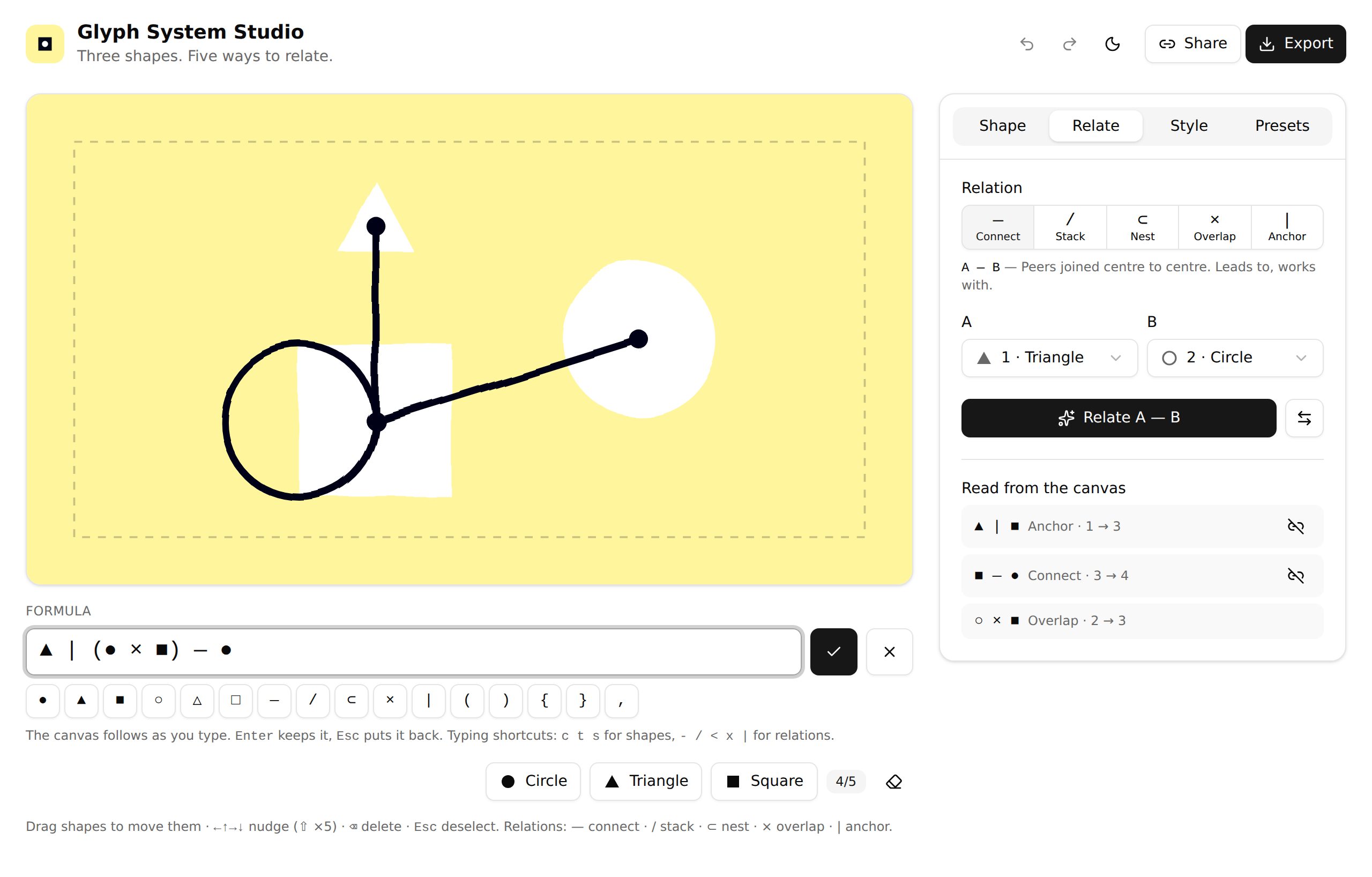
A formula typed in, drawn as you write, and its relations read back from the canvas.
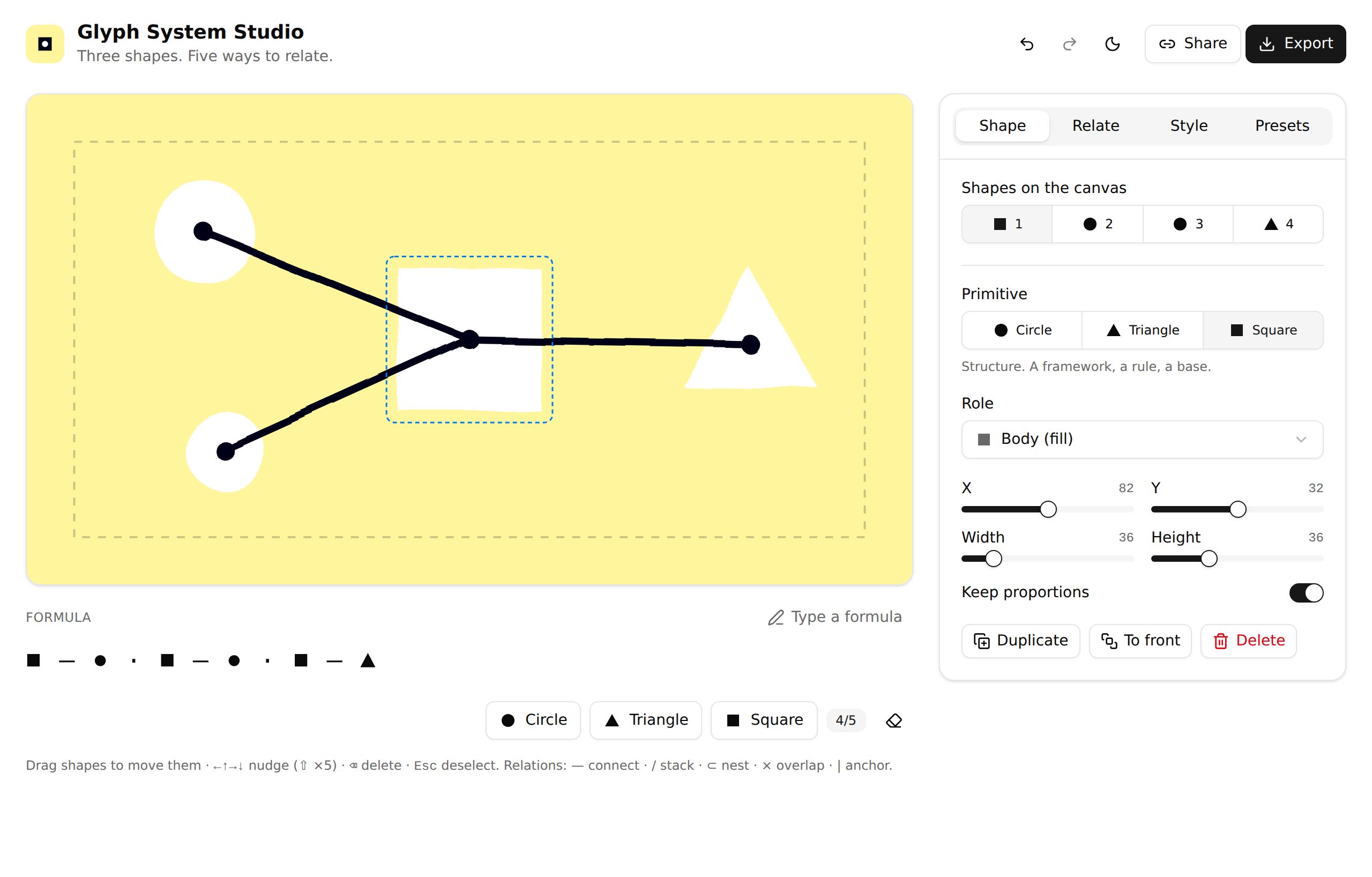
Shape. Pick a primitive and its role, then size it or drag it. A body carries its nested marks.
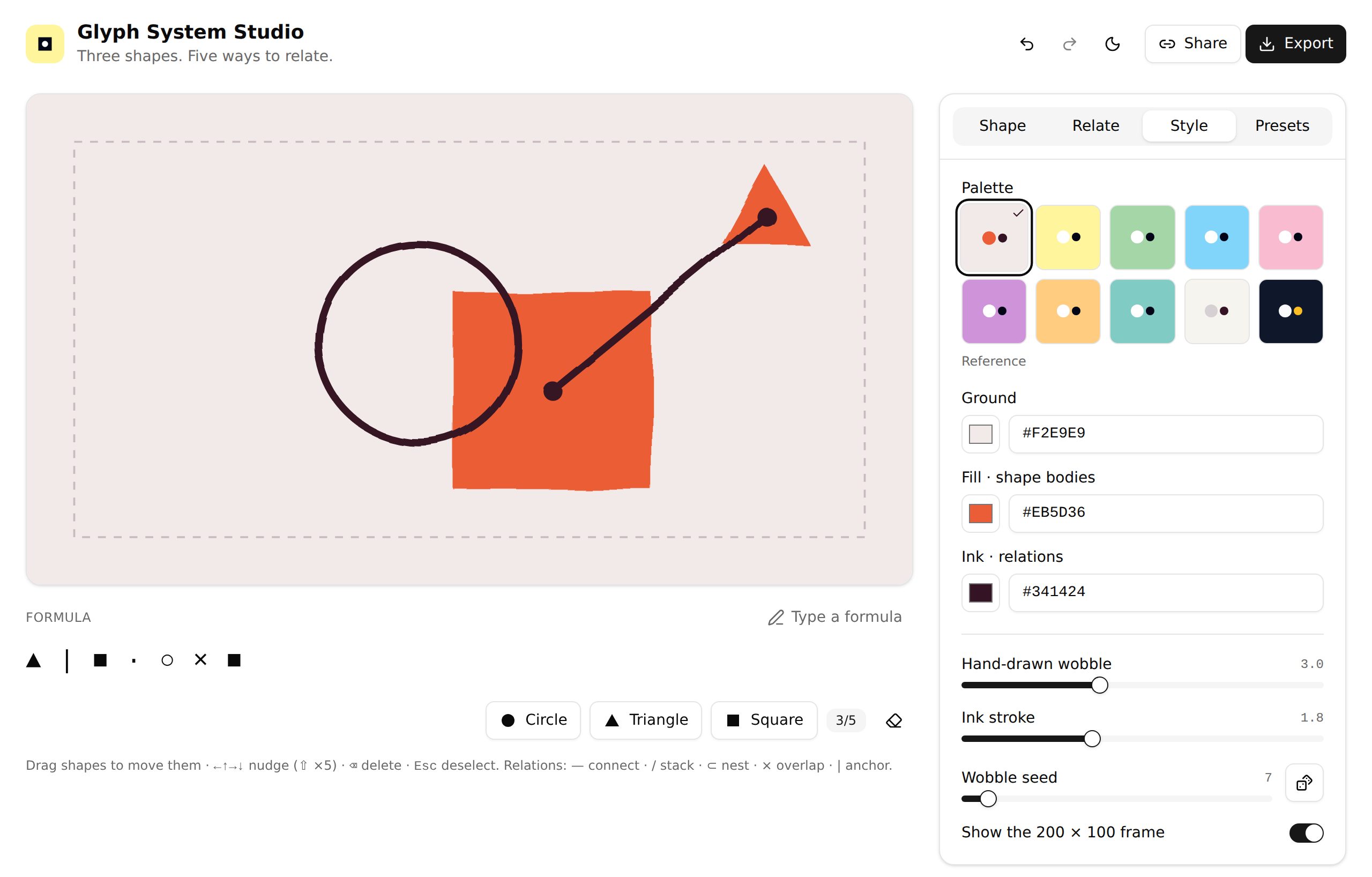
Style. Palettes, ground, fill and ink, plus how hand-drawn the line feels.
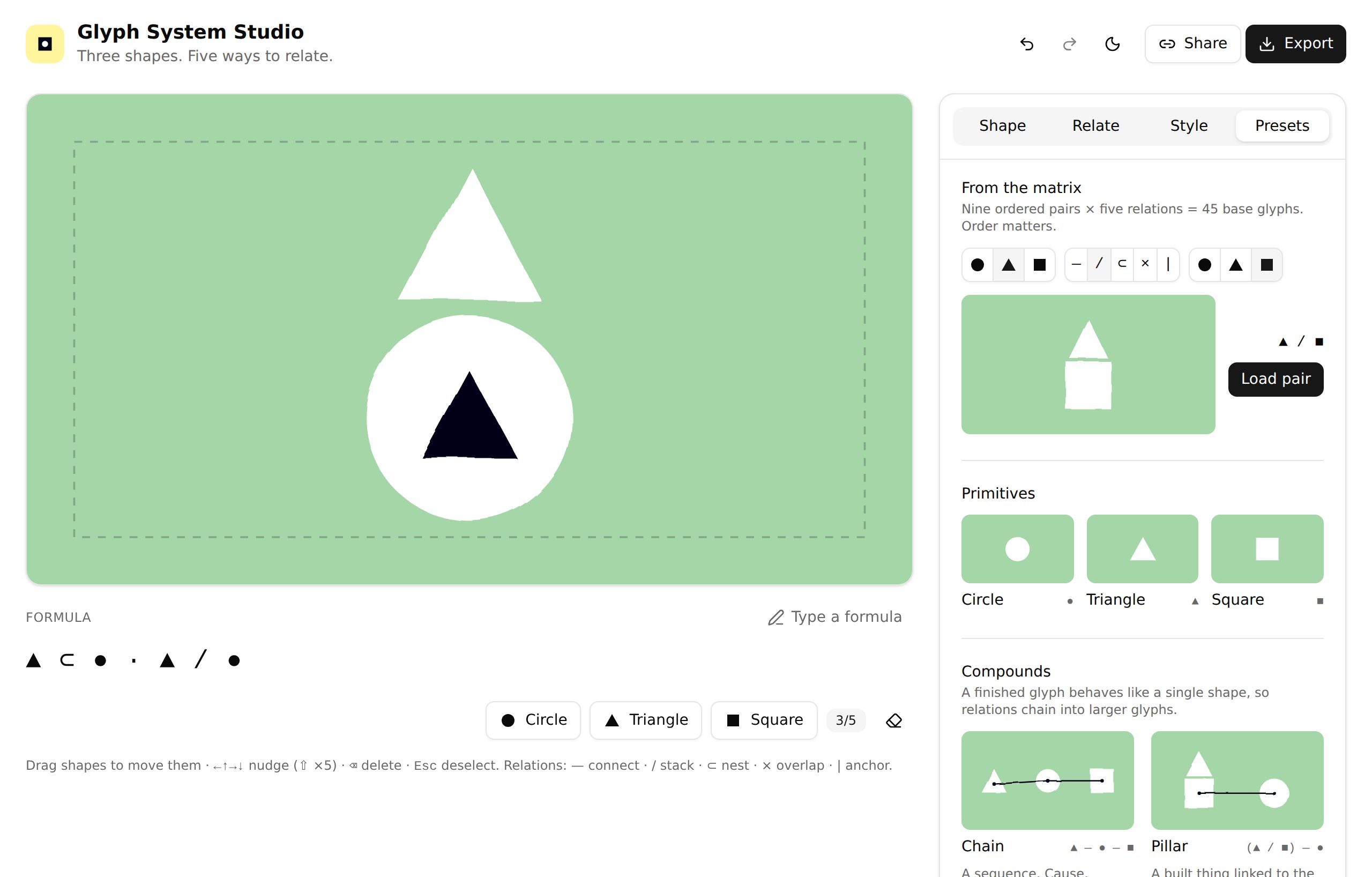
Presets. Any of the 45 matrix pairs, the primitives and every compound, one click away.
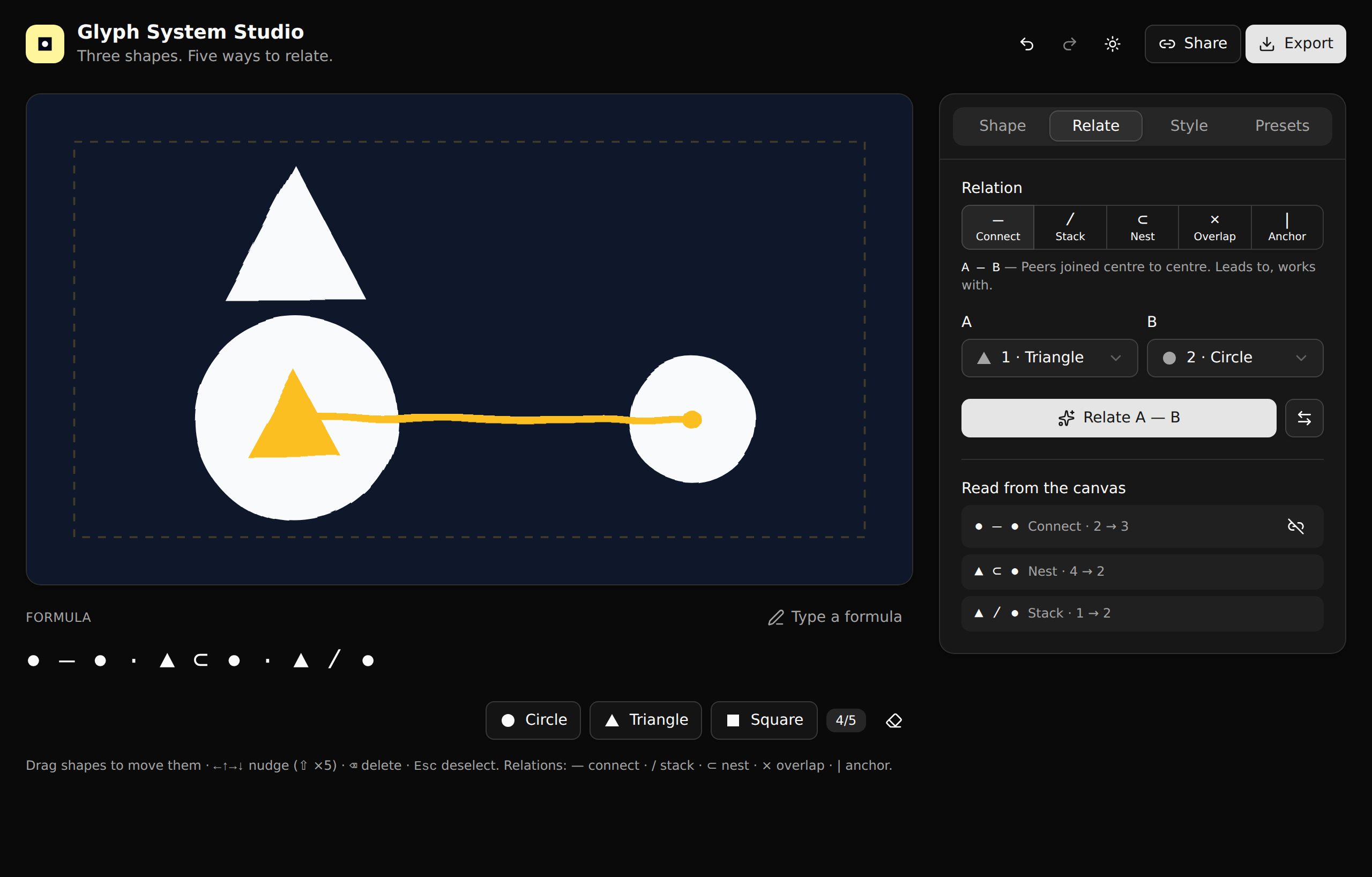
Relate. Pick A, a relation and B; everything the grammar reads off the canvas is listed underneath.
Every post so far
The rules
- Three primitives, five relations. Nothing else.
- Five shapes at most.
- No text inside a glyph.
- One formula per post, never repeated.
- Colour comes from the post's topic, never picked per glyph.
▲ | (● × ■)A flag raised over shared ground: two relations working at once, the way a system does.