Koa Foundations. No internet? We cover you.
The impact
Removed technical barriers by designing for offline-first experiences, resulting in a seamless, inclusive experience that ensures users never lose progress.
My Role
Senior Product Designer, Koa Foundations — working alongside a PM, engineering team, and a researcher to design the offline-first experience end-to-end, from discovery through handoff.
The context
How would our world be different if we were optimistic about the possibility of fast and reliable Internet connectivity, but did not take it for granted?
Even as we transition from 4G to 5G, according to the Ericsson Mobility Report, there are still a lot of areas where mobile networks are slow or simply not available. Nearly 1.6 billion people around the world live outside the range of mobile internet networks. Millions more bounce in and out of network connectivity when on-the-go.
Most apps start with an incorrect assumption — that offline is, by default, an error state and they stop users from doing anything. Instead, we should think from user's point of view and allow them to finish their goals.
Depending on the location, the internet connection might vary from WiFi to 4G, 3G to 2G to no internet at all, and at Koa Health we seek to better cater for a large number of people worldwide with technical barriers to mental health.
Use cases
Removing technical barriers to mental health
There are plenty of reasons you may not have internet or a slow connection:
- Poor or no coverage in area
- Can't afford a data plan for your phone.
- On transportation with intermittent connectivity
- On a flight
- On extreme weather conditions
- Internet connection is managed by a third party and it will be active or inactive
- And an extensive etc
The Challenge
The anxiety of losing the work done
When we introduced Multidevice feature in Foundations a new set of user scenarios appeared. The ones that worried the team more were related to the anxiety of losing the work done in the app while jumping from one platform to another, specially when working offline and joining from other connected online device.
Considerations
Guiding principles
When kicking off the initiative we were at good starting point:
- Designing for offline first ✅
- Don't block content ✅
- Provide an offline experience by default ✅
Then, while doing product discovery — including usability testing that revealed how disorienting connectivity loss was for users mid-session — we researched and defined a set of best practices. We realized we were missing guiding principles critical for the new multidevice scenarios:
- 👀 Clearly indicate offline functionality
- 🔔 Notify users when connection is restored
- 📱 Update the UI to reflect the current contextual state
- 📴 Educate the user so they understand what the offline model is
- 💻 Make experiences transferable from one device to another
- 🔄 When the connection is reestablished sync the progress
- 🛟 Provide sense of safety and not overburden them with messaging
- 👅 Use simple, concise language
Our first instinct — and the default behavior in most apps — was to block content entirely and show an error state. Usability testing showed this was the wrong call: users interpreted blocking as data loss, which triggered exactly the anxiety we were trying to prevent. That rejection became the founding principle of the whole solution: never block, always inform.
Offline patterns
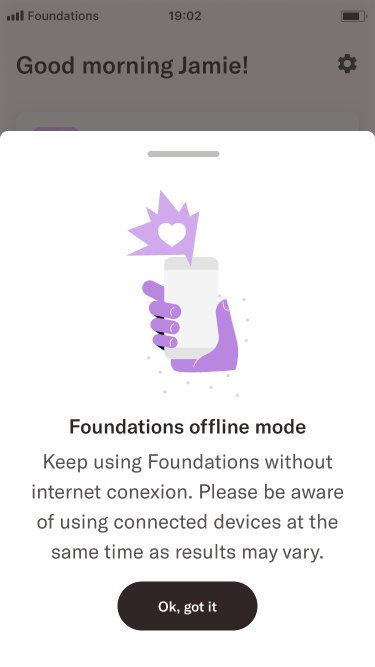
Contextual once-in-a-lifetime message for indicating what the offline model is.
Instead of being transparent when offline, we clearly indicate it without blocking the experieence.
Results
Inclusive by default, understandable and seamless
We ended up enhancing the application to the next level by improving accessibility for those with limited or inexistent connectivity, providing sense safety, information transparency, control, and awareness.
Offline design is an essential part of understanding and responding to users' needs.
Sussana Zarasky